
Finding Hillsborough County Residents
Start with the fact that can be checked, not with a broad guess. The Hillsborough County Property Appraiser accepts an owner name, address, folio, or parcel number. It can connect a person to land, but an owner may live elsewhere and a renter will not appear. For a current voter, the Supervisor of Elections verifier uses a first name, last name, birth date, and sometimes a house number. Historical searches belong at the library, where printed directories, census access, obituary indexes, maps, and newspapers can place a person in a particular year.
The Hillsborough County residents directory is best treated as a set of evidence trails. A deed records a legal transaction. A voter entry confirms registration, not every household member. A court docket records a party's role in a case, not fault. Keep the source date and the exact role beside every result. When two records disagree, the newer record is not always right; it may record a mailing address, business contact, or later event.
- Search HCPA by owner or address and save the folio, situs address, mailing address, and legal description.
- Use the Hillsborough voter lookup only when the required identity fields are known.
- Compare the name in Official Records and HOVER, which search different record systems.
- For an older household, check the precise directory year, census, obituary index, and maps.
- If an index ends, ask its custodian for a defined record series, date range, and electronic format.
Hillsborough County Records Custodians
Records are divided by legal duty. The Clerk records deeds and other instruments and also maintains county and circuit court files. HCPA appraises parcels and publishes owner, mailing, situs, value, exemption, and sale fields. The Supervisor of Elections keeps voter registration data. County departments use a separate public-records request process and expressly route deeds, mortgages, liens, courts, and sheriff records to their own custodians. Detailed address work belongs in the Hillsborough County street directory.
Supervisor of Elections
2514 N Falkenburg Road
Tampa, FL 33619
813-744-5900
Voter Information Lookup
Reading Hillsborough Property Results
The HCPA result separates the situs address, where the land is located, from the owner's tax mailing address. That distinction is often the strongest lead in a name search. The mailing address may point to another residence, a post-office box, a trust, or a management firm. Save the parcel's folio and full legal description before following any sales instrument to the Clerk. Homestead status can support owner occupancy, but it never identifies every resident.
The HCPA search screen shows the county's main property entry point.
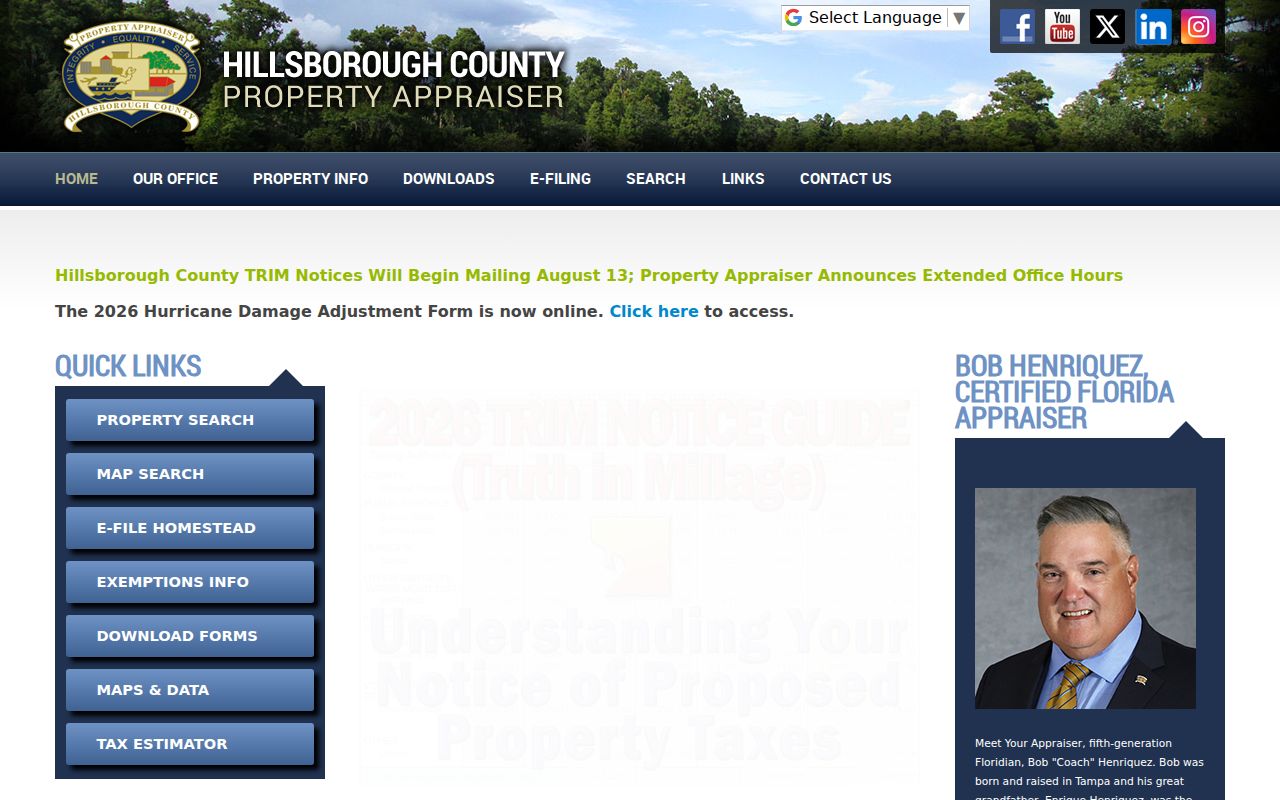
The owner, address, folio, and parcel routes make the roll useful from either a name or a known location.
- Situs address
- The official physical location of the parcel.
- Folio
- Hillsborough County's short parcel identifier.
- Legal description
- The lot, block, subdivision, or land description that remains useful when street numbers change.
For nearby parcels and jurisdiction clues, open the HCPA GIS map.
Parcel outlines provide a defensible way to identify the lots beside and across from a known address.
Hillsborough Clerk Searches Compared
Two Clerk systems answer different questions. Official Records indexes recorded instruments such as deeds, mortgages, satisfactions, liens, plats, notices, and marriage documents. HOVER searches circuit and county court cases by party, business, case number, date, and case type. A search in one does not replace the other.
| Clerk source | Best input | What a match means | Fallback |
|---|---|---|---|
| Official Records | Party, instrument, book/page | A role in a recorded document | Clerk counter, old books, certified copy |
| HOVER | Party, business, case number | A role in a court case | Public terminal or archived-file retrieval |
Search grantor and grantee roles separately, and try former names, initials, spouses, trusts, and business entities. An image can carry return addresses and legal descriptions that the index does not show.
The Clerk landing page routes users to its distinct record services.
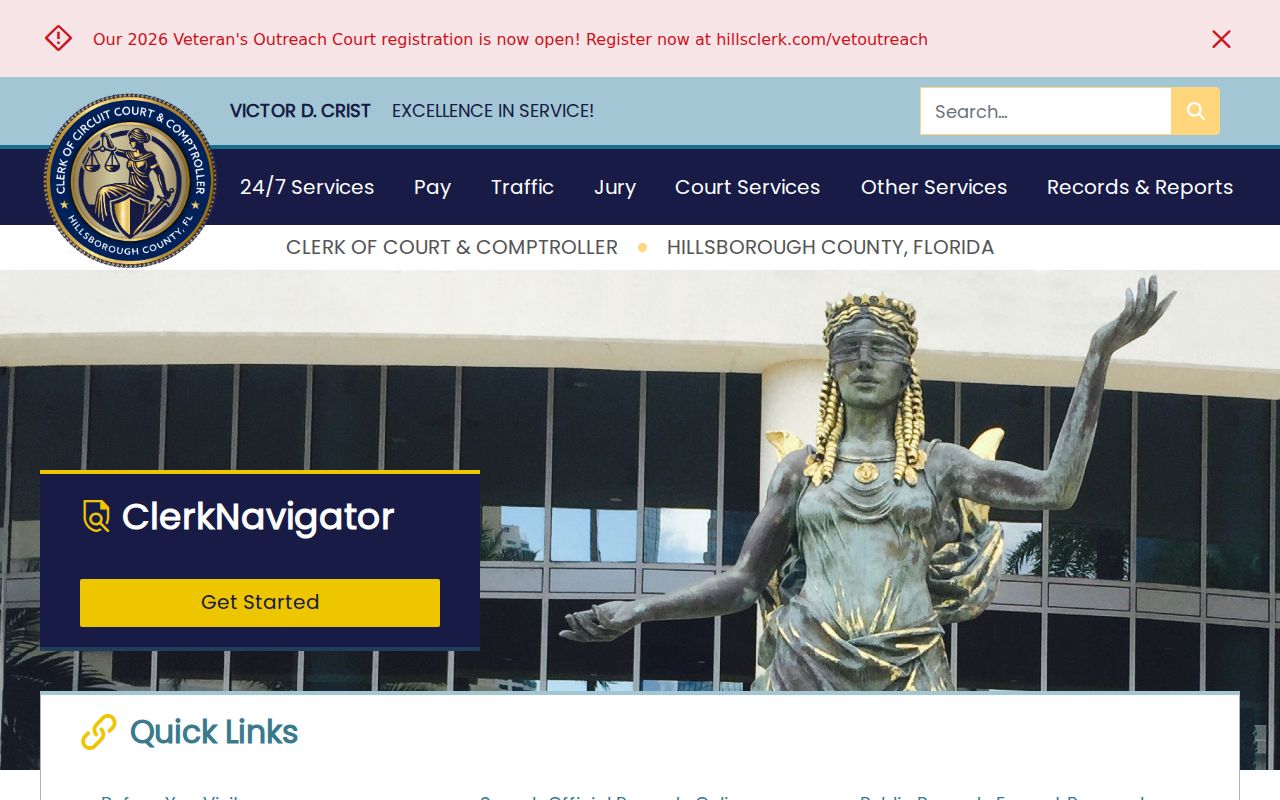
Choosing the correct Clerk branch prevents a deed search from being mistaken for a court search.
The separate HOVER interface illustrates the court-record route.
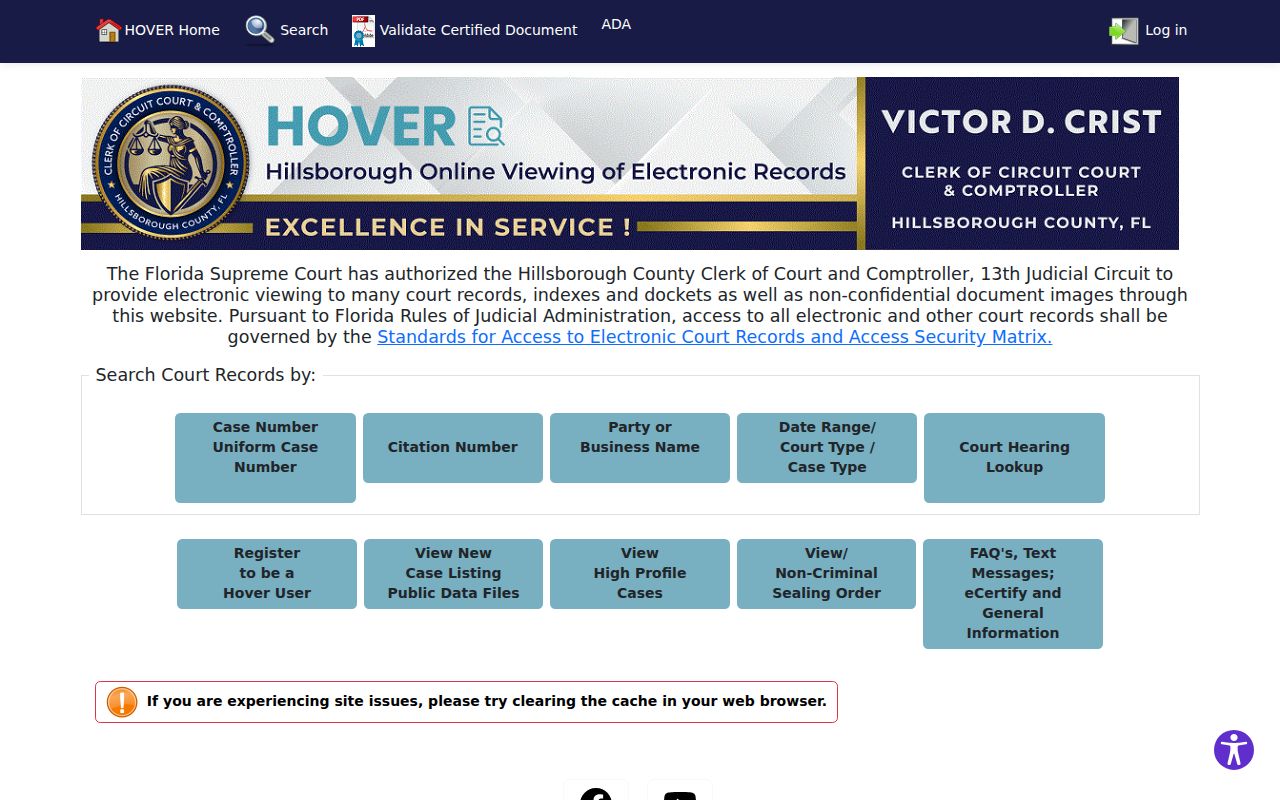
Read the party role and event chronology before treating a same-name docket as a match.
Current Hillsborough Resident Rolls
Modern Hillsborough County resident records are purpose-built lists, not a household directory. The property roll identifies owners and tax mail recipients. Election records cover registered voters, with protected people and confidential fields removed. Recorded documents name parties to transactions. Court indexes identify litigants and other case roles. Business filings can corroborate a public company role or address, but a registered-agent address may be commercial.
| Source | Who It Lists | Keeper | Access |
|---|---|---|---|
| Property roll | Owners and tax addressees | HCPA | Free search and downloads |
| Voter records | Public registered voters | Supervisor of Elections | Verifier, reports, or request |
| Official Records | Parties to recorded instruments | Clerk | Free index; copy options |
| HOVER | Public court-case parties | Clerk | Index and eligible images |
| Neighborhood registry | Organizations and contacts | County Neighborhood Relations | Public map, not member rosters |
Use the Hillsborough County resident lookup workflow to compare two independent custodians. Never convert an owner's name, a court party, or a corporate officer into a claim about current residence without added evidence.
Checking Hillsborough Voter Records
The Voter Information Lookup verifies one voter with identity inputs rather than offering open street browsing. A successful response may show status, party, precinct, districts, polling place, election information, and participation history. Participation never reveals ballot choices. A nonmatch may reflect a move, spelling, list maintenance, protected status, or incorrect input.
For broader lawful research, the Data and Records Requests page offers monthly standard reports and a custom request process. Florida Statute §97.0585 protects identification numbers, registration-location data, preregistered minors' information, and signature copying. Other exemptions protect certain addresses.
The official voter-data page shows those access routes.
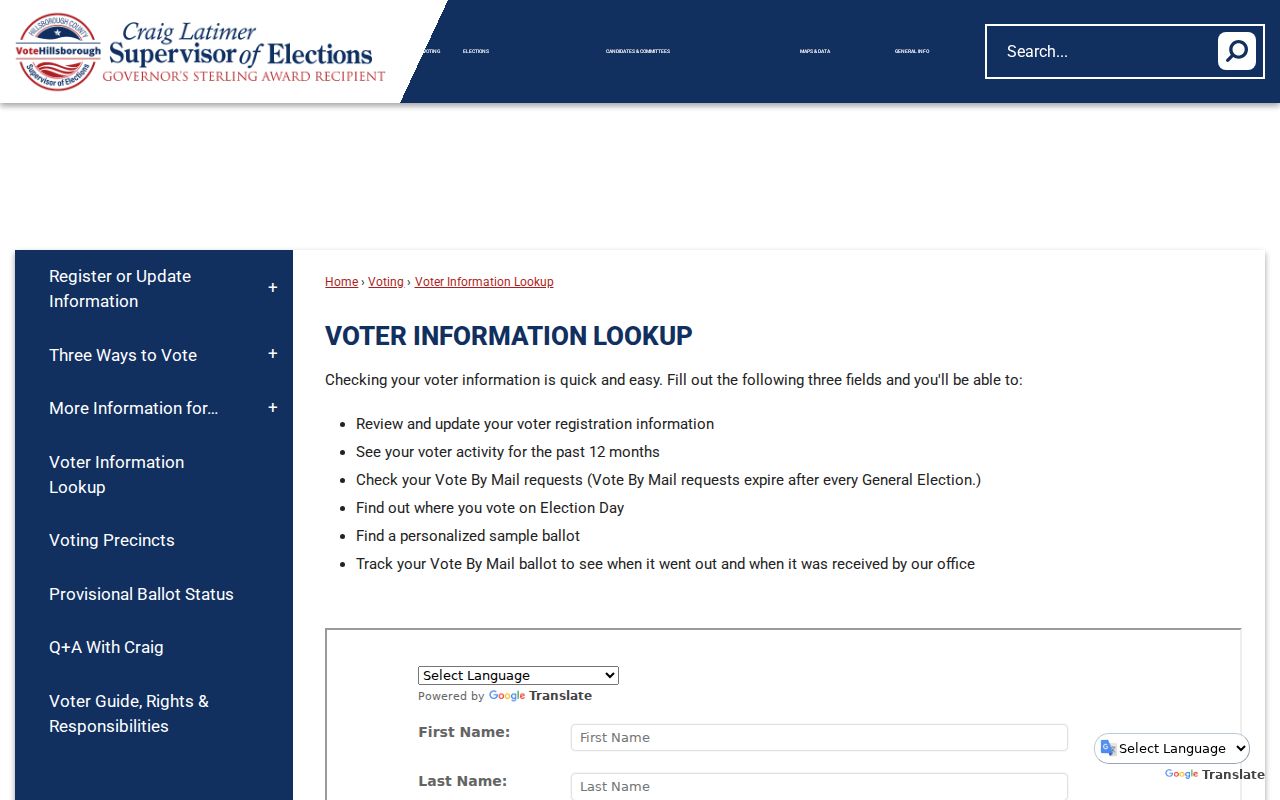
The split between individual verification and dated public files helps users choose the proper channel.
Requesting Hillsborough County Records
Florida's Public Records Law, Chapter 119, allows a focused request without explaining a motive. Name the custodian, record series, date range, identifiers, and desired electronic format. Hillsborough County reviews whether records exist and then provides an estimate of time and cost. Its posted policy charges extensive research after 30 minutes at the lowest-paid capable employee's rate; the first ten paper pages are free, later pages cost $0.15, and requests of $49 or more require advance payment.
The county request portal also explains which requests belong elsewhere.
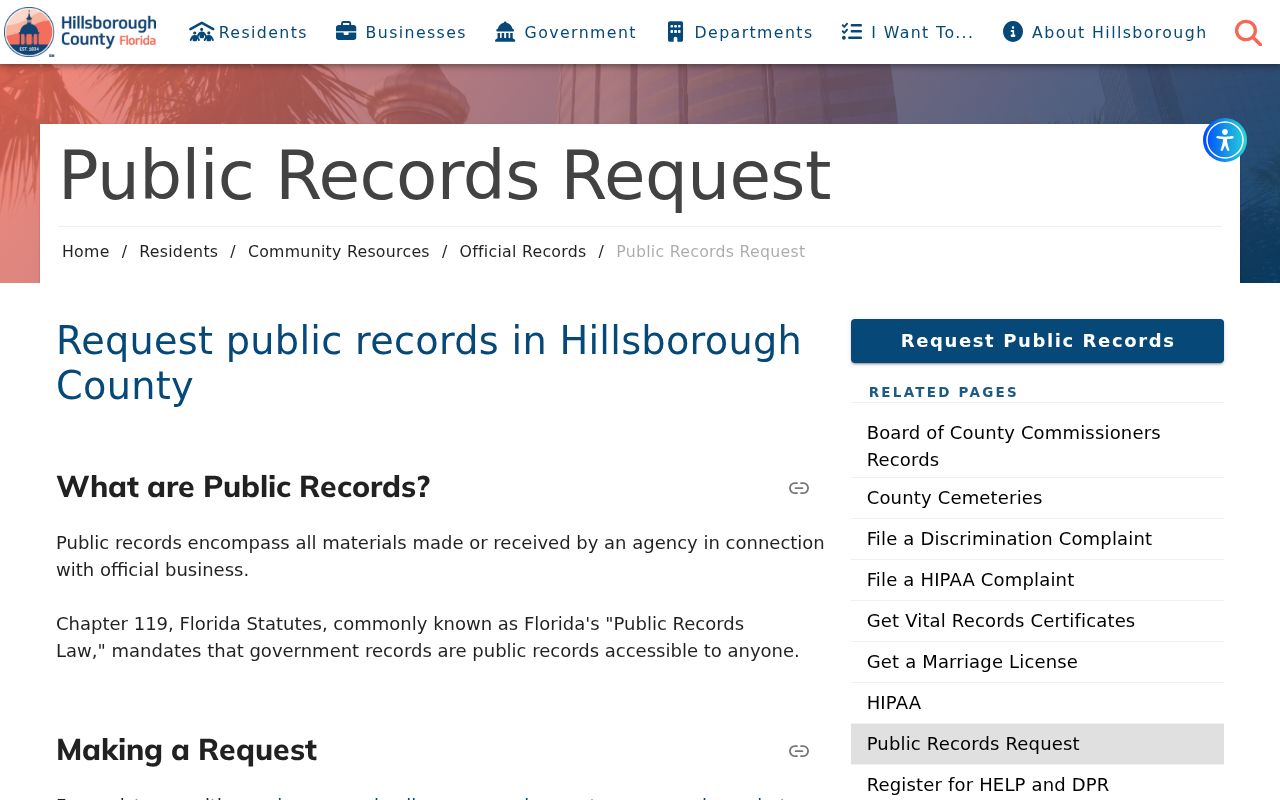
Deeds and court files go to the Clerk, while sheriff records go to HCSO. Correct routing saves time.
Insider tip: Ask to inspect records before ordering copies, and narrow dates or fields when a labor estimate is high.
Following a Tampa Postal Address
A Tampa mailing label does not establish City of Tampa jurisdiction. Hillsborough County also contains Plant City, Temple Terrace, and large unincorporated areas. Check the exact parcel in HCPA and, when needed, the Tampa City Limits lookup before requesting permits, code cases, police reports, or city archives. ZIP areas are delivery geography, not government boundaries.
This distinction matters throughout the Hillsborough County residents directory. Tampa permits can identify an owner, applicant, contractor, project date, folio, and official address. County permits cover unincorporated property, while Plant City and Temple Terrace keep their own municipal records. A permit proves a project connection, not that the named person lived there.
Hillsborough Vital Record Limits
Birth, death, marriage, and divorce records use separate access rules. Under Florida Statute §382.025, birth records remain confidential for 125 years. Death certificates without cause are public, while cause-of-death information is restricted for 50 years. Marriage and dissolution certificates are public and generally state-held from June 6, 1927. Earlier marriage and divorce evidence belongs with Clerk books, archives, newspapers, church records, and library microfilm.
Use the Florida vital-record forms library for the correct statutory application. A confidential certificate should never be sought through a casual Chapter 119 request. Applicants must follow eligibility, identification, signature, and payment rules for the record type.
Business Filings Confirm Public Roles
Sunbiz can connect a person to a Florida entity through officer, director, manager, registered-agent, principal-address, and filing-image fields. Historical annual reports are especially useful because a current summary may replace former officers. Search older report PDFs to build a chronology. The address might be an office or agent location, so it should support, not settle, a resident match.
The state's DBPR license search adds public occupation and license-status evidence. Florida Treasure Hunt can reveal a possible former holder or address association and is free to search, though identity proof is required to claim property. Neither source replaces the originating county roll.
Hillsborough Directory Evidence by Date
A reliable resident search records when each source was created. The property card may display current ownership while its mailing address reflects an earlier update. Voter reports change through moves, returned notices, deaths, and list maintenance. A court docket can contain an address from the first pleading and a later address in a notice. Business summaries show current officers, while annual-report images preserve former roles. Put the event date, filing date, recording date, and search date in separate columns rather than treating them as one timeline.
This method also controls same-name errors. Write down the middle initial, suffix, approximate age, spouse or associate, known street, occupation, and the period being checked. Compare two independent custodians. A parcel owner, corporate agent, court party, and voter with the same name may still be different people. When the fields do not settle the match, label it as possible and record what additional fact would distinguish the candidates.
Key point: A public address is evidence of a dated connection, not automatic proof of a person's present home.
Hillsborough Library Records Beyond Directories
HCPLC's local collections fill gaps that modern indexes cannot. The Tampa Bay Obituary Index covers 1855 through 1990, and the Tampa Bay History Publications Index covers 1925 through 1999. The Burgert Brothers archive holds more than 20,000 photographs from the late nineteenth century through the early 1960s. Early funeral-home records can identify relatives, a residence, and burial details when newspaper text recognition or civil-certificate access falls short. These are leads that should be checked against the original image, directory page, or certificate.
Access also varies by channel. Some digital collections are free from home. Ancestry Library Edition and some newspaper resources require library access, while HCPLC's FamilySearch affiliate status can open images unavailable on an ordinary home account. The Florida History and Genealogy Library keeps physical directories, microfilm, maps, photographs, vertical files, and local publications. Robert W. Saunders Sr. Public Library adds African-American genealogy holdings and Freedmen's Bureau microfilm from 1865 through 1872. Ask for an exact title, year, publisher, call number, and alphabetical or reverse section before traveling.
When Hillsborough Online Indexes Stop
An empty web result does not prove that no record exists. The Clerk's Official Records index commonly reaches to about 1964, while earlier deeds may remain in books, microfilm, or archived files. A public court event may lack a remote image because of Florida's court-access matrix, a scanning gap, or a restricted attachment. HCPA shows current parcel data and selected history, not every archived tax roll. State certificate coverage also begins later than many Hillsborough families' events.
Use the identifier from the newest available source to cross the cutoff. A deed's book and page can lead a Clerk employee to an older volume. A case number, Uniform Case Number, and docket-event number define a court copy request. For property history, keep the folio, subdivision, lot, block, and legal description, then ask for the archived tax roll or plat. Historical directory work should specify the edition year and whether the alphabetical or street section is needed.
Several access routes may exist for the same series. Clerk public terminals and the records counter can provide material not shown remotely. Uncertified or certified copies can be requested by mail or electronically, and eCertify can deliver an electronic certified item by email. HCPA offers downtown and Brandon service counters, telephone help, dated parcel and sales downloads, and printable maps. The library supplies physical volumes, microfilm, licensed databases, and research-request channels. Record the name of the office contacted, the request date, its response, and any quoted retrieval time.
Florida requests should be narrow enough for the custodian to identify existing records. Ask for a record series and date range rather than asking staff to research a person. State the electronic format desired and request a cost estimate. If extensive labor is predicted, reduce the period or fields. A precise fallback request is often more useful than repeating a failed search with the same spelling.
Hillsborough Property Fraud Alerts
The Clerk's free Property Fraud Alert monitors newly recorded documents for a registered name and sends a notice when a match appears. It is an early-warning service, not a lock on the Official Records system. It cannot prevent a document from being recorded, decide whether a filing is valid, or replace review of the actual image. Common names may also produce alerts unrelated to the subscriber.
When an alert arrives, compare the party role, instrument type, recording date, instrument number, legal description, and image with the known parcel. Contact the Clerk about its record and legal process; contact law enforcement when fraud is suspected. HCPA directs owners to the service, but HCPA remains the appraiser, not the recording authority. This office split is another reason a Hillsborough County residents directory result must be traced to the custodian that created it.
Historical Hillsborough Resident Directories
The Florida History and Genealogy Library at John F. Germany Public Library is the central historical shelf. Its holdings include Tampa city and telephone directories, obituary and publication indexes, newspapers, maps, photographs, and local files. Verified R.L. Polk examples include 1910, 1916, and 1927, but the library does not publish a complete year-by-year shelf list. Call 813-273-3652 for the exact edition and access needs.
The HCPLC genealogy portal connects the directory shelf to census, obituary, newspaper, Sanborn, and licensed databases.

The full Hillsborough County city directory method explains how alphabetical and reverse sections track a household through changing addresses.