
Hillsborough City Directory Holdings
The Florida History & Genealogy Library at John F. Germany Public Library is the main local shelf. Its catalog, not a generic year list, controls which city directories are available. R.L. Polk & Co. published Tampa directories, with specific examples verified for 1910, 1916, and 1927. Various other years are held, but no official online inventory proves an unbroken run. Call 813-273-3652 and ask staff to confirm the year, publisher, alphabetical or reverse section, format, and call number before traveling.
| Collection | Years | Where Held | Access |
|---|---|---|---|
| R.L. Polk Tampa directories | Examples verified for 1910, 1916, 1927; other years vary | Florida History & Genealogy Library | Catalog, shelf, or microfilm |
| Tampa Bay Obituary Index | 1855-1990 | HCPLC | Online index and request service |
| Tampa Bay History Publications Index | 1925-1999 | HCPLC | Online |
| Burgert Brothers photographs | Late 1800s to early 1960s | HCPLC Digital Collections | Free online |
| History & Genealogy Records | Early funeral files, 1850 census, maps | HCPLC Digital Collections | Free online |
| Sanborn Tampa and Ybor maps | 1892 and 1899 verified; later editions cataloged | Library of Congress and HCPLC | Free or licensed access |
| Freedmen's Bureau microfilm | 1865-1872 | Robert W. Saunders Sr. Public Library | Archives room |
Directory coverage follows publication and collecting history, not a neat annual sequence. The shelf also includes telephone directories, newspapers, maps, photographs, vertical files, family histories, and local works that help bridge a missing volume. Federal census schedules are public through 1950 as of 2026, while the 1960 census opens in 2032 under the 72-year rule.
Access may be online, on an open shelf, on microfilm, or through a licensed library database. Those channels are not interchangeable. A catalog hit confirms that an item exists, while a staff check can confirm whether the needed edition contains an alphabetical list, a business section, or a reverse street section. For remote work, send the exact printed name, address form, and year range rather than asking for every mention of a family. A focused request gives staff enough detail to check the correct volume and helps preserve the page citation needed for later verification.
Inside Hillsborough's Genealogy Library
John F. Germany Public Library combines local reference books, microfilm, city and telephone directories, maps, newspapers, photographs, and vertical files. The HCPLC Genealogy & History portal also points to Ancestry Library Edition, FamilySearch, Newspapers.com World Collection, Fold3, Sanborn maps, Florida Memory, and USF Special Collections. Access differs: Ancestry is in-library, and the library's FamilySearch affiliate status can open images that are unavailable from home.
Staff accept obituary research requests and can help identify a publication or catalog record. Ask a narrow question with a name, time window, address, and desired directory year. Robert W. Saunders Sr. Public Library adds the county system's only African-American-focused genealogy reference collection, including Freedmen's Bureau microfilm, neighborhood binders, rare books, and memorabilia. These sources help counter omissions or segregation in some commercial publications.
Other repositories add different layers. USF Special Collections and the Tampa Bay History Center's Touchton Map Library hold manuscript, map, cigar-industry, immigrant, and neighborhood material. Florida Memory supplies state catalog and digital items. NARA records provide census, military, immigration, and naturalization context, while Catholic Diocese and congregation archives can bridge years before civil registration, subject to each repository's rules. Start at HCPLC, then move outward only when the city directory points to a trade, faith community, institution, or neighborhood that another collection documents more closely.
Hillsborough History Online
The HCPLC Digital Collections provide photographs, records, oral histories, and archival sets without a trip to the reading room. The captured landing page shows the collection entry point.
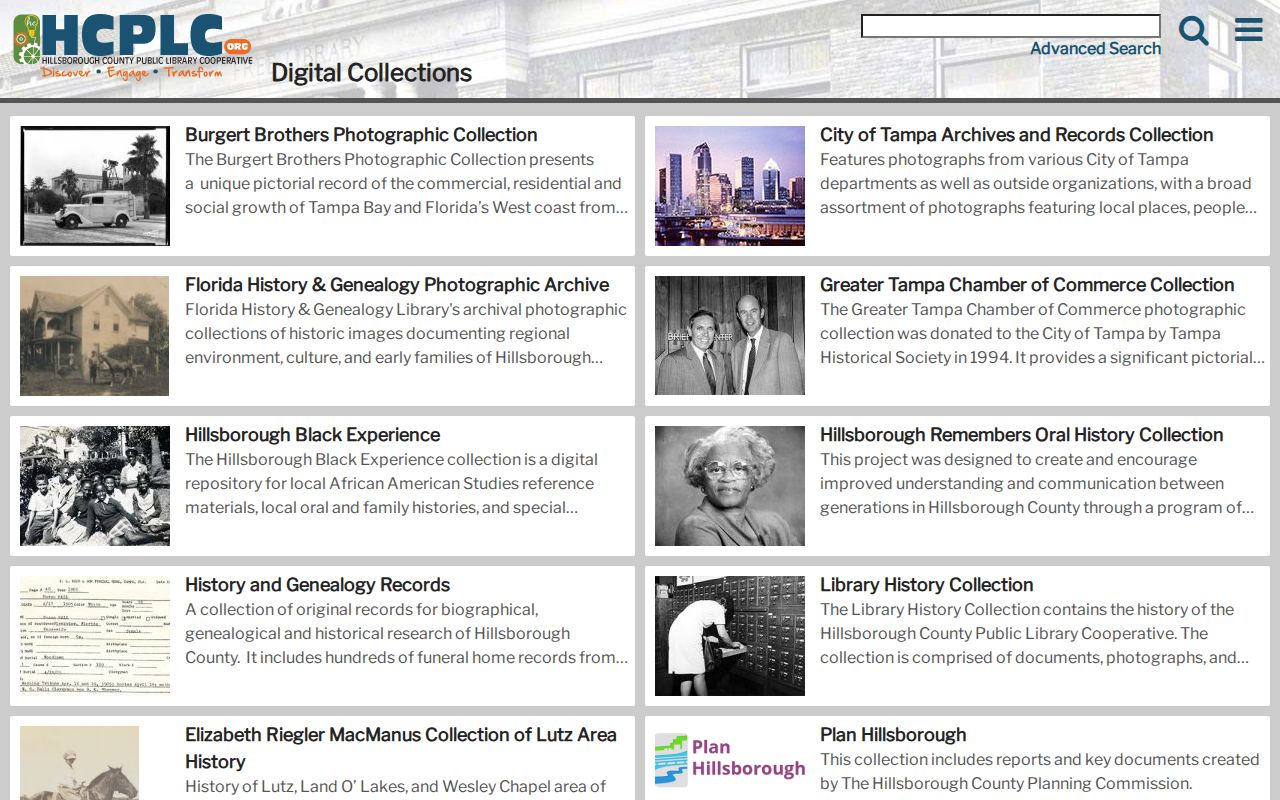
The Burgert Brothers archive alone exceeds 20,000 images and spans the late nineteenth century through the early 1960s. A city directory address can therefore lead to a street, building, shop, or event image, even when the individual is not named in the photo record.
The focused History & Genealogy Records collection includes early twentieth-century funeral-home material, the 1850 agricultural census, and maps.
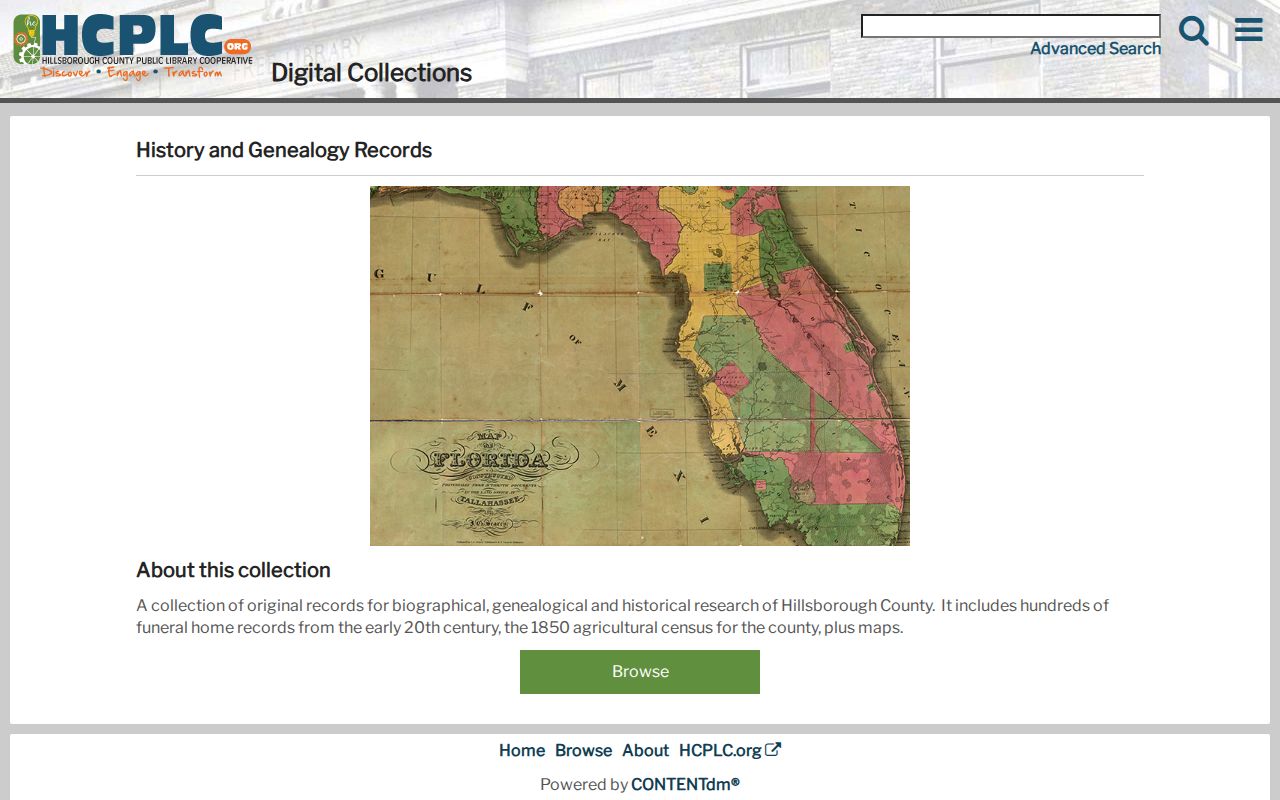
Funeral-home files can supply relatives, residence, and burial clues when newspaper text recognition fails or a civil certificate remains restricted.
Read a Hillsborough Directory Entry
Read every city directory entry against the abbreviation key for that edition. Polk formats changed, and not every volume records the same facts. Preserve the printed text before expanding an abbreviation. Also record the edition date and likely canvass lag, because a volume labeled for one year may reflect information gathered months earlier.
| Name | Printed resident, head, spouse notation, or business name |
|---|---|
| Occupation | Trade and sometimes employer, useful for namesakes |
| Address | House number, street, and sometimes a half address |
| Owner mark | An edition-specific symbol that may distinguish owner from renter |
| Widow notation | “Wid” plus a deceased spouse, which narrows a death window |
- Criss-cross directory
- A street-order section that lists addresses and printed occupants rather than starting with surnames.
- Householder index
- An address-based list of household heads, not a complete list of everyone at the address.
- Abbreviation key
- The edition's guide to marks for residence, boarding, widowhood, work, and ownership.
Create a ledger with directory year, printed name, spouse, occupation, employer, address, owner or renter mark, page, and notes. That audit trail makes later comparisons far more reliable.
Search the spouse and business sections when the expected head of household does not appear. Widow entries can be especially useful because the deceased spouse's name narrows a death window, but the notation still needs support from an obituary, death record, cemetery source, or probate file. Employer abbreviations also matter in Tampa. A cigar factory, railroad, port firm, or boarding house can separate two residents who share a surname and initial. Never expand an unfamiliar code from memory; copy the key from that same edition because abbreviations can change between publishers and years.
A Tampa Half-Address Clue
A local HABS study shows why exact transcription matters. The 1910 Tampa City Directory listed J.E. Oglesby at 2410 Twelfth Street and P.G. Hager at 2410½ Twelfth Street. In 1916, Garcia & Rosas appeared at the address. Whole and half numbers can represent distinct historical occupants or uses, so dropping the fraction can merge separate entries.
Tampa records may switch between “12th” and “Twelfth,” and Ybor or West Tampa names may be shortened, inverted, or split differently across English and Spanish-language sources. Search compound surnames both ways. Cigar factories, railroad work, port businesses, and boarding houses can also distinguish two people with the same name.
Map Hillsborough Directory Gaps
Directory absence does not prove that a person left Hillsborough County. The address may have stood outside Tampa's city limits, used another number, appeared under a spouse or business, or been missed by the publisher. The Pauline Kilker House is a local example: it was outside the city limit and absent from a Sanborn map, yet appeared in the 1927 directory and 1928 tax roll before deed books extended the trail.
The Library of Congress holds a free 1892 Tampa and Ybor City Sanborn atlas with ten sheets; an 1899 set has 33 sheets. Sanborn maps show footprints, building material, use, and older street numbering. Pair them with tax rolls and deeds only after translating the old address or lot description. A directory is publisher evidence, not a sworn government residence record.
City limits are only one source of mismatch. Directory canvass dates can precede the cover year, a rural route may not map cleanly to a later street, and annexation can move an address into a different municipal record system without moving the building. Preserve every printed form in the research ledger, including directional words, fractional numbers, and numeric versus spelled-out streets. Then use a plat, Sanborn sheet, tax roll, or deed legal description to test whether two forms identify the same place.
Hillsborough Directory Research Timeline
These verified milestones help place a volume among companion records. They do not imply that every intervening city directory survives.
| 1855 | Tampa Bay Obituary Index coverage begins. |
|---|---|
| 1892 | Ten-sheet Tampa and Ybor City Sanborn atlas is available. |
| 1910 | Verified Polk entry distinguishes a whole and half address. |
| 1916 | A business appears in the documented Twelfth Street example. |
| 1927 | A verified directory helps document the Pauline Kilker House. |
| 1950 | Most recent public federal census as of 2026. |
Photograph the title page, publication date, and key with every entry. This preserves the source context when compilation lag or a publisher change affects interpretation.
Trace Hillsborough Families by Directory
A city directory works best as one dated observation in a longer family-history trail. Begin with a known name, address, or year, then move in small intervals. Keep possible matches separate until an address, spouse, trade, or another independent source supports the link.
- Find the earliest likely entry in the alphabetical section. Search a spouse and business section if the expected name is absent.
- Move forward one available edition at a time. Record changes in address, spouse notation, occupation, and employer.
- Use a criss-cross section, when present, to read several addresses above and below the target.
- Pair the directory with the 1900 through 1950 public censuses, tax rolls, deeds, permits, and Sanborn maps.
- Close a departure or death window through the obituary index, funeral records, cemetery evidence, or probate docket.
One disappearance has several explanations: a move, death, omission, changed street number, residence beyond city limits, or listing under another household member. An obituary and probate file may point to heirs, while a deed can connect the same lot to a later owner. For a current address-keyed search rather than historical shelf research, use the Hillsborough County street directory.