
Hillsborough Previous-Resident Sources
No single Hillsborough County record names every person who occupied a property. A deed proves a transfer of an interest in land, while a directory is a publisher's observation and a census is a dated household count. Begin with the source closest to the target year. Then compare it with a source created for a different purpose. That distinction prevents an owner from being mislabeled as an occupant.
| Source | Verified local span | Keeper | Best evidence |
|---|---|---|---|
| Official Records index | About 1964 to present | Hillsborough Clerk | Parties, instrument, deed image, legal description |
| Earlier deed books | County formation era forward, with gaps | Clerk records library | Grantor, grantee, book/page, parcel chain |
| Polk Tampa directories | Examples confirmed for 1910, 1916, 1927 | HCPLC | Printed occupants, firms, address and reverse listings |
| Federal census | Public through 1950 | NARA and library databases | Household, relationship, age and occupation |
| Sanborn maps | Tampa/Ybor editions confirmed for 1892 and 1899 | LOC and HCPLC | Building footprint, use, material and old number |
| Tax and permit files | Coverage varies by jurisdiction | HCPA and local building office | Owner, improvement and construction dates |
The online cutoff is not the start of the land record. It is the point where the access channel changes. Older Hillsborough County previous-resident work may require the Clerk counter, deed books, microfilm, a library catalog search, or a focused records request.
Start Hillsborough Address History Today
Search the Hillsborough County Property Appraiser by address. Copy the owner and co-owner names, situs address, mailing address, folio, long parcel number, legal description, subdivision, sale date, and linked instrument. Situs means the physical property address. The mailing address is where the tax notice goes, and it may belong to a trust, company, or owner elsewhere.
The legal description matters more than the modern house number. It ties the lot to a subdivision, lot, block, or longer land description even when a road name or number changes. A homestead exemption can support owner occupancy, but it does not identify every past resident. Current roll data can also lag a newly recorded deed, so note the date shown on each source.
For current address methods across a full road, use the Hillsborough County street directory. The backward trail here stays fixed on one parcel.
Walk Hillsborough Deeds Backward
The Hillsborough County Clerk of Court & Comptroller is the recorder. Its Official Records search and the HCPA sale pointer work together. Search both indexed roles: the grantor gives property away, while the grantee receives it. A chain can fail if only one role is searched.
- Open the current HCPA parcel card and record the exact legal description, owner, folio, and newest sale instrument.
- Find that instrument in the Clerk Official Records index. Read the deed image for grantor, grantee, dates, parcel wording, and earlier references.
- Search the seller as a grantee during the earlier period. Filter for deed types and keep the same lot or legal description.
- Repeat from transfer to transfer. Treat mortgages and satisfactions as time clues, not ownership transfers.
- At the web cutoff, take book/page references to a Clerk public terminal, records counter, or microfilm collection.
- Grantor and grantee
- The grantor transfers an interest; the grantee receives it.
- Chain of title
- The linked series of transfers for the same land.
- Legal description
- The formal parcel wording that remains useful when a street address shifts.
Anonymous users can search ordinary public instruments online. Restricted images may need eligible subscriber access. Copies may be requested by instrument number or book/page, and the Clerk's eCertify option can deliver an electronic certified copy by email. For pre-index work, call the Clerk and ask for the exact book, page, party, and year instead of requesting an open-ended search.
Past Residents Beyond Hillsborough's Index
An empty web result does not prove that no deed exists. The roughly 1964 online reach varies by record class, and Hillsborough County began in 1834. Earlier books may use land descriptions rather than a street number. Clerk terminals and the records library are the first fallback. HCPLC maps, plats, tax rolls, and directories can help establish the old parcel before a staff request.
Provide former and current owner names, bounded dates, book/page if known, and the legal description. Ask whether inspection is available before buying copies. If a custodian expects extensive labor, narrow the dates or request an existing index. Florida Public Records Law does not require a requester to explain the research purpose.
Several access paths can serve the same search. HCPA supplies the sale and instrument pointer, but the Clerk holds the filed deed. Florida Memory, State Archives catalogs, and FamilySearch affiliate images can supplement early volumes. HCPLC staff can help locate the directory, tax, plat, or map evidence needed to identify an old lot. At the Clerk counter, ask for inspection of the cited book or image. For a remote copy, specify whether an ordinary copy is enough or whether certification is needed. Keep the request narrow and retain the response with the research notes.
Match Hillsborough Households by Year
Owners are only part of the story. The Florida History & Genealogy Library at John F. Germany Public Library holds Tampa and Hillsborough directory families, obituary and newspaper microfilm, maps, photographs, and local files. A directory may name a householder, spouse, occupation, firm, widow status, or homeowner mark. Fields differ by edition, so save the title page and abbreviation key.
- Choose the directory nearest the target year and check the alphabetical name list.
- If that edition has a street or criss-cross section, find the road and read entries above and below the number.
- Compare the next available edition to mark arrival, departure, spelling, firm, and spouse changes.
- Pair the address with the nearest public census schedule, then test the household against tax, deed, obituary, and probate evidence.
The dedicated Hillsborough County city directory collections page explains the shelves and how entries are read. Ask HCPLC at 813-273-3652 for exact years and call numbers, because the public library page does not promise an unbroken run.
A Hillsborough Half-Address Clue
A 1910 Tampa directory separated 2410 Twelfth Street from 2410½ Twelfth Street. HABS research placed J.E. Oglesby at the whole number and P.G. Hager at the half number. By 1916, Garcia & Rosas appeared at the address. The small fraction matters: ignoring it can merge distinct households or miss a business that used the same site later.
Try numbered and word forms such as 12th and Twelfth, directional prefixes, old numbers, and half addresses. Search a year on either side, since a directory canvass can predate its cover year. In Ybor and West Tampa, also test both parts of compound surnames, initials, Spanish and English forms, and a cigar-company name.
Map Earlier Hillsborough Addresses
The Library of Congress 1892 Tampa and Ybor atlas contains ten sheets, while research confirms a 33-sheet 1899 edition. Sanborn maps can show a building footprint, construction material, use, outbuildings, and old street numbering. They do not name every occupant.
Pair the map with a directory entry and the deed's legal description. A missing building can mean the site lay outside that map's city coverage, not that the home did not exist. Historic Tampa core and Ybor respond well to this method. Mid-century suburbs lean more on plats, deeds, tax rolls, and directories, while recent county growth calls for parcel, permit, and GIS records.
The HCPLC Digital Collections open Hillsborough photographs, maps, oral histories, and local records online.
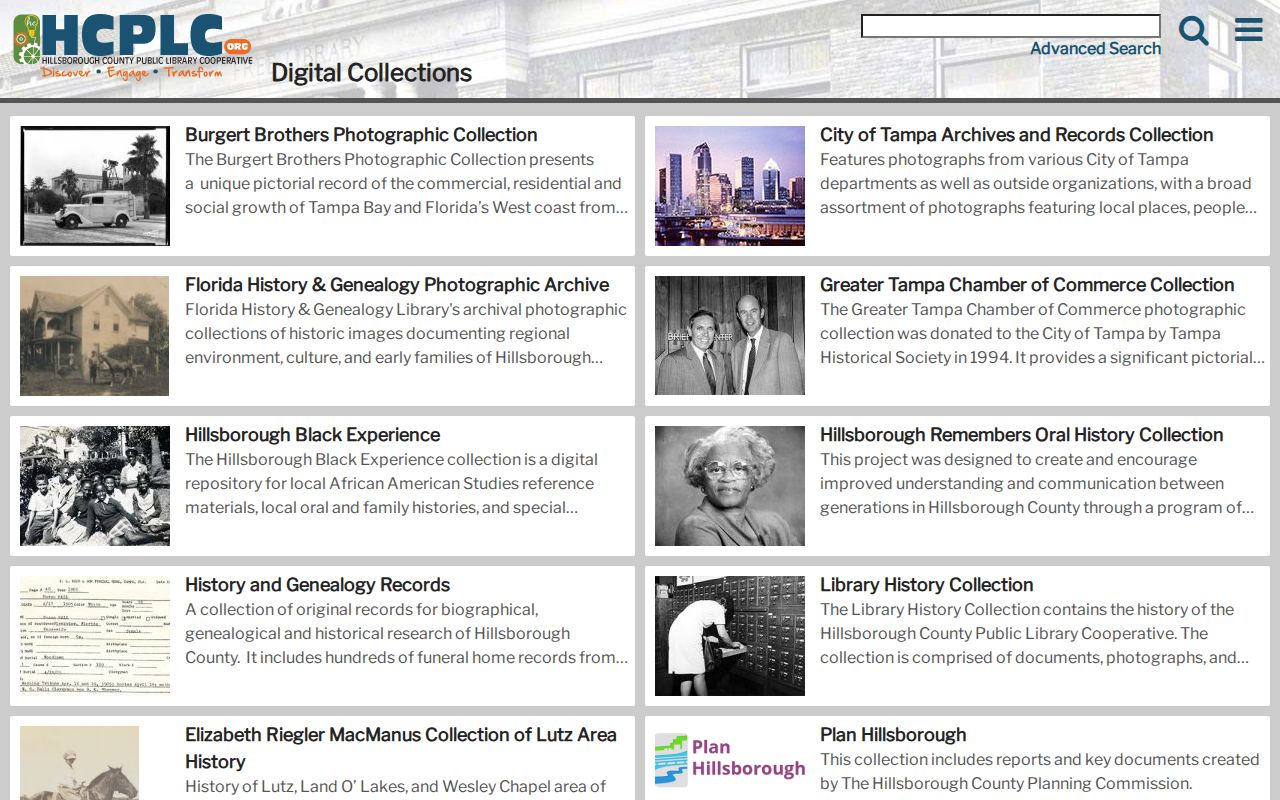
The collection view helps place an old address in the right archive before a shelf or research request.
Hillsborough's Kilker House Trail
The Pauline Kilker House study shows why previous residents cannot be recovered from one list. The property sat outside Tampa's city limit and was omitted from the relevant Sanborn coverage. It appeared in a 1927 directory and as a separate parcel on the 1928 tax roll. The cited deed trail then moved through Books 936, 950, 1413, 1735, and 3463, with transfers documented across later decades.
This is a practical model. When the map fails, test the directory. When a street entry appears, confirm the parcel in a tax roll. When the owner is known, use deed books to move across time. A gap in one collection becomes a reason to change sources, not a reason to invent continuity.
Close Hillsborough Resident Trails
Obituaries and probate can connect a former owner to relatives, heirs, and later places. HCPLC's Tampa Bay Obituary Index spans 1855 through 1990, and its early twentieth-century funeral-home files may record relatives, residence, service, burial, and death details. HOVER can locate a public probate docket by decedent or personal representative, though confidential inventories and accountings may be withheld.
Explore the HCPLC History & Genealogy Records collection for funeral-home files, maps, and the 1850 agricultural census.
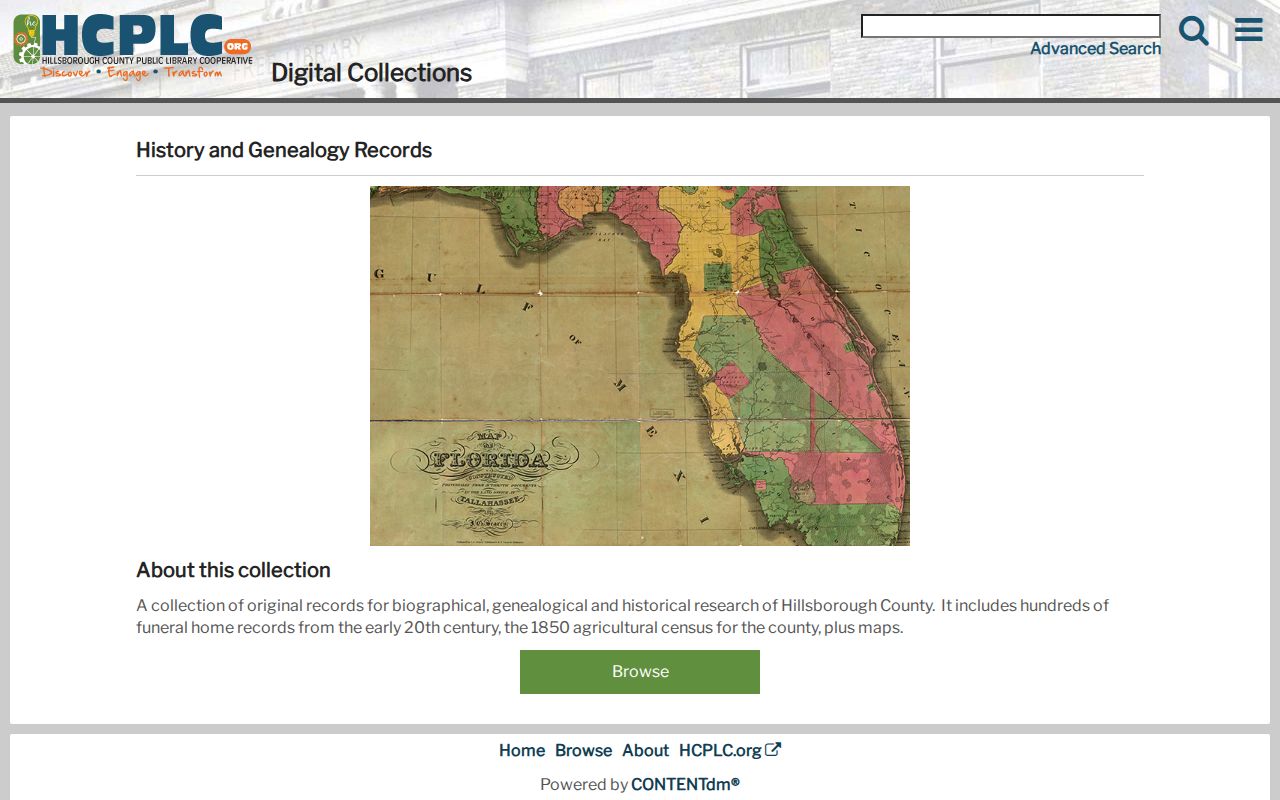
Those records can supply a family link when newspaper text is poor or certificate access is limited.
Use the trail lawfully. House and family history do not justify tracking, threatening, or harassing a living person.
Record every source date and distinguish proof from a clue. A deed proves a named role in a land transfer. A directory supports printed presence. A census describes a household on its enumeration date. Together, they can produce a careful Hillsborough County previous-resident timeline without claiming more than the records show.